
- If you have ever done reef-keeping, you are likely to have committed mistakes at one point or another. Ideally, reef keepers would like a perfect start where they build a thriving and healthy saltwater aquarium on the first attempt, but it’s no more than wishful thinking.
Getting it wrong is not only frustrating but also a loss of your time and money. Instead of going through trial and error, a better approach is to watch out for mistakes from the get-go so that you can establish a successful Saltwater Fish Tank Setup. No matter what your tank size is, reefing is a full-time endeavour that takes time and practice to master and get the desired results.
Here are the most common reef tank mistakes and how to sidestep them from day one.
Mistake #1: Adding Fish Too Early
After spending hundreds or thousands of dollars on equipment and setup, it feels really hard to wait 4-6 weeks to add your favourite fish. The temptation to “just add one small fish” is one of the few new reef tank mistakes that can be catastrophic in the long term.
In the early days of your tank, beneficial bacteria are still colonising your live rock, sand, and filter media, and initiate the nitrogen cycle, which converts toxic ammonia into less harmful compounds. Without sufficient bacteria, ammonia and nitrite levels spike, poisoning any fish you add. Reef tank cycling mistakes will often end with dead fish, before you realise that the parameters have reached dangerous levels.
How to avoid it:
- Test religiously: Regularly check ammonia, nitrite, and nitrate every 2-3 days during cycling.
- Wait for zero: Don’t add fish until you register a reading of 0 ppm ammonia and 0 ppm nitrite for seven consecutive days.
- Resist peer pressure: Don’t fall for other hobbyists claiming”I added fish at 3 weeks and they were fine,” as every tank is different.t
- Occupy yourself: Use the cycling period to research fish compatibility, design your aquascape, and join online reef forums.
Letting your tank complete its full cycle before stocking can dramatically improve your success rates.
For more science-backed coral reef care knowledge, you can explore NOAA’s Coral Reef Conservation Program:
Mistake #2: Overfeeding Your Fish
It’s nearly impossible to resist the sight of a Fish begging for food like your cat. Fish have a tendency to get excited whenever you approach them, which can make you feel that they are starving.
In reality, fish have very small stomachs and slow metabolisms. Overfeeding fish in a reef tank is one of the biggest saltwater aquarium mistakes, as they will gobble up food whenever it is available. Ultimately, your fish become obese, their immune systems weaken, and they become susceptible to diseases. Our blog, The Science Behind Nano Tank Stability: Buffering, Alkalinity & Calcium, can help you understand how the different parameters interact to
Here’s what happens when you overfeed:
- Reef tank ammonia spike due to the buildup of fish waste and decomposing food
- An increase in nitrogen levels that fuels algae blooms
- Cloudiness in water and a film that develops over the surface.
- Drop in oxygen levels as bacteria decompose waste
- Explosive algae growth as hair algae, cyanobacteria, and diatoms, covering everything
How to avoid it:
- Feed your fish in only small amounts that can be completed in 2-3 minutes.
- Feed once or twice daily. Mature fish can actually go days without food safely.
- Skip one day per week to give a break to their digestive systems and prevent waste buildup.
- Variety matters more than quantity. Rotating between high-quality pellets, frozen foods, and occasional treats provides better nutrition than large amounts of the same food.
- If you can detect uneaten food on the sand or rocks 5 minutes after feeding, it’s a sign you have overfed and need to cut down portions right away.
Mistake #3: Using Tap Water
Using tap water in a reef tank seems to be a free, convenient, and “good enough” option. One of the most critical reef tank mistakes is to assume that tap water is as safe for aquariums as it is for drinking. Many beginners find spending money on RO/DI systems or buying purified water an unnecessary expense.
However, a tap water saltwater aquarium is filled with chemicals and minerals that are threatening to marine ecosystems. For instance, chlorine kills beneficial bacteria and burns fish gills, while heavy metals (copper, lead) are toxic to invertebrates and corals, even in trace amounts.
Similarly, phosphates and silicates are responsible for algae blooms, especially diatoms and hair algae that are hard to control. Eventually, you find your corals turn pale and more cases of fish.
How to avoid it:
- Invest in an RO/DI system: Opt for 4-5 stage units from well-reputed brands (BRS, Aquatic Life, Spectrapure) that provide lab-quality water.
- Buy water initially: Purchase RO/DI from local fish stores while you save for your own unit.
- Begin by testing your tap water for nitrate, phosphate, and silicate to see what you’re working with.
- Using “conditioned” tap water is a big no. Dechlorinators only remove chlorine, but nitrates, phosphates, or heavy metals remain intact.
Mistake #4: Skipping Quarantine
Beginners simply skip quarantine tanks, as this comes with the costs of buying extra equipment and putting in extra time. After all, when you bring home that beautiful new fish, you want it in your display tank immediately, not isolated in a bare hospital tank.
This is one of the most deadly saltwater aquarium mistakes, as Marine fish and corals from stores can host invisible threats like parasites, bacterial infections, viruses, and even coral pests such as Flatworms, nudibranchs.
On the surface, it may seem your display tank is thriving, and you see no harm in adding one new fish directly from the store. Within 3-7 days, the parasite covers every fish in the tank until you see white spots on your fish and fish scratching on rocks and breathing heavily.
How to avoid it:
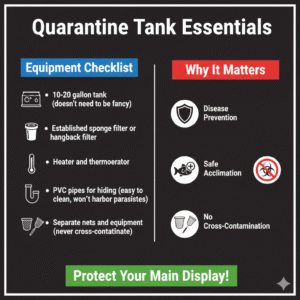
- Set up a hospital/quarantine tank with a capacity of 10-20 gallons and equipped with a sponge filter, heater, and PVC pipe. Hiding spots
- Observe any new fish you add for 4-6 weeks while corals take a 2-4 weeks minimum
- Look out for any disease signs and promptly treat in quarantine, not display tank
- Allow fish to acclimate properly to water parameters.
Investing in a basic quarantine setup will cost merely $75-150, but losing an entire well-established livestock collection is worth hundreds or thousands.
Mistake #5: Adding Too Many Fish at Once
Suppose that your tank has finally cycled after you’ve waited patiently for 6 weeks, and now it’s time for fish! Assuming your tank is ready, you decide to add 5-6 fish at once to quickly create that dynamic, vibrant look you’ve envisioned.
Reef tank stocking mistakes can be dangerous, as the nitrogen cycle is stable for zero fish waste. Introducing multiple fish at once causes waste production to multiply instantly, while the bacterial colonies haven’t had time to expand to handle this new bioload. Rushing this process leads to a bacterial lag where Ammonia and nitrite spikes in the next 3-4 days, and eventually, by Day 8-14, the immune system is compromised, and fish develop secondary infections.
How to avoid it:
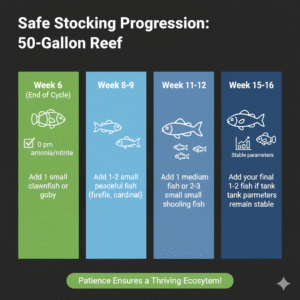
- Add fish gradually: One fish every 2-3 weeks allows bacteria to adjust to increased bioload.
- Start with small fish: Low bioload species first (gobies, small clownfish) before larger waste producers (tangs, angels).
- Monitor closely: Test ammonia and nitrite 2-3 times per week for the first month after each addition.
- Be patient: A fully stocked reef takes 6-12 months to build safely
Tanks stocked gradually have higher pay-offs that survive long-term with less disease, and more stable water parameters.
If you need further help with planning tank size and stocking levels, check out our guide From 10 to 150 Gallons: How to Build the Perfect Saltwater Reef Aquarium.
Mistake #6: Buying Incompatible Fish
Fish species are generally captivating, from the electric blue damselfish to the beautiful purple dottyback. The desire to buy them is natural, but doing so without asking whether they are hardy or not can invite a slew of problems.
That’s because marine fish have complex social structures and vary immensely in their territorial behaviours and dietary needs. Species that coexist peacefully in massive ocean environments may become aggressive when confined to a glass box. For instance, pairing aggressive fish like Dottybacks, damsels will harass or kill gentle fish like gobies, firefish, while territorial conflicts can arise when fish compete for the same rock caves or swimming zones will fight constantly.
Explore our Reef Fish Compatibility Chart to know what combination of reef fish is compatible to ensure harmony and peace in your saltwater Aquarium.
How to avoid it:
- Spend 30 minutes researching every species you’re considering to avoid
- Use compatibility charts to determine which fish coexist peacefully.
- Consider the adult size of your choice. A cute 2-inch porcupine puffer will grow to 10 inches and needs 100+ gallons of space as an adult.
- Add peaceful fish first to help them establish before introducing semi-aggressive ones.
- If you have a territorial fish, rearrange rockwork before adding new fish to reset territories.
The bottom line is that if you can’t keep a fish happy and healthy for its entire 5-15 year lifespan at adult size, don’t buy it.
Mistake #7: Not Testing Water Parameters Regularly
Water testing is time-consuming, costs money (test kits range from $10-100 each), and seems unnecessary when “everything looks fine.” This might make you feel why bother with testing, but it’s reef tank mistakes
as Marine aquariums are closed systems where invisible problems accumulate slowly. A gradual nitrate rise from 5 ppm to 60 ppm or a slight drop in pH from 8.2 to 7.8 can seem harmless, but trigger algae and stall growth.
Parameters can crash anytime, so it might be too late before you check symptoms (algae, sick fish, dying corals). The purpose of testing is to reveal problems or trends while they’re still cheap and easy to fix.
How to avoid it:
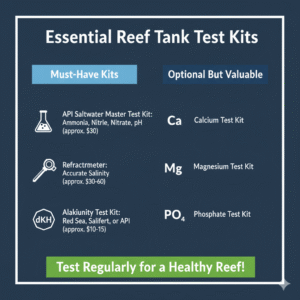
- Monitor key parameters like Salinity, temperature, ammonia, nitrite, and nitrate every 7 days to maintain stable nano reef chemistry.
- Test bi-weekly for stability parameters like pH, alkalinity, calcium, and magnesium every 14 days.
- Keep a record of all data in a physical or digital log to help you track dates and all results.
- Focus on trends, not single readings. One high reading might be misleading, while a trend signals an underlying problem.
- Test before and after changes: Always test 24 hours after water changes, adding livestock, or equipment modifications.
Conclusion
If you study closely enough, you will see a pattern emerging in these beginner reef tank mistakes that can be traced to either impatience or inconsistency. You may attempt to rush the cycle, feed too much too soon, take shortcuts on water quality, or neglect testing routines.
Reef keeping is a pursuit that rewards a patient and persistent hobbyist who is eager to learn. In the final analysis, the reef keeper who takes 12 months to fully stock a tank is at an advantage over one who fills it in just 2 months.
Learn how an Aquarium Maintenance App can improve your Tank Health to eliminate common beginner mistakes and invest your time and money in a thriving reef tank.
For more science-backed coral reef care knowledge, you can explore NOAA’s Coral Reef Conservation Program.