
The Complete Guide to Reef Tank Dosing Supplement: Mastering Essential Elements for Thriving Corals
Reef Tank Supplement Dosing Guide: Magnesium, Iron, Potassium & More
If you’ve spent any time in the reef-keeping hobby, you already know that maintaining a thriving coral reef tank is about more than just assembling beautiful marine life and saltwater. Any successful reef tank can be traced to a carefully balanced internal chemistry that can make or break your reef aquarium’s success.
A critical factor in this regard is the choice of the right supplements or food for reef tank inhabitants, as well as proper supplement dosing to ensure healthy, vibrant, and colorful corals.
In this comprehensive dosing supplements for reef tanks guide, we’ll break down everything you need to know about the best dosing supplements for reef tanks and their dosing rules to follow to set up a successful saltwater aquarium.
Understanding the Foundation: Core Elements of Dosing Every Reef Tank Needs
Before diving into specific supplement dosing strategies, let’s establish the foundation. You can think of your reef tank chemistry as an interconnected system where elements like calcium, alkalinity, and magnesium work together in harmony. If any one of these elements becomes too high or too low, its effects spiral down in the entire reef tank setup.
Alkalinity, measured in dKH, provides the carbonate ions that corals need to calcify and build their structures. It should ideally be between 8-12 dKH, though it’s more important to maintain stability within a narrower range than hitting a specific number.
If you’re still building your system, a solid saltwater tank setup is the first step before moving on to supplement dosing.
Magnesium Supplement Dosing for Reef Tanks (Stability & Growth)
Magnesium supplement dosing acts as the “biological glue” to achieve water chemistry stability. This is because when magnesium levels fall below 1200 ppm, it becomes chemically impossible to maintain calcium above 400 ppm. Without adequate magnesium, your reef tank alkalinity is likely to swing to extremes, leading to unstable conditions that can stress or even kill sensitive corals.
Magnesium supplement dosing has a fascinating role to play in reef aquariums. Magnesium ions inhibit the spontaneous precipitation of calcium carbonate, essentially keeping calcium “available” in the water column longer so corals can actually use it.
Without adequate magnesium dosing, calcium and alkalinity combine too quickly and fall out of solution. As a result, the reef corals are deprived of essential elements, with white deposits forming on your equipment and rocks.

Proper Magnesium Supplement Dosing Techniques for Reef Tank
Start by testing your magnesium level with a reliable kit (Salifert or Red Sea), then calculate the dose needed to reach your target. In the case of most reef aquariums, the amount of magnesium required is comparatively lower than that of calcium and alkalinity, although larger systems can take up hundreds of milliliters.
A two-part dosing system, either in the form of magnesium chloride and magnesium sulfate solution, can supply the proper ratio of ions found in natural seawater. Dose slowly into a high-flow area of your tank to prevent localized concentration spikes.
Split the dose over 1-2 days to avoid stressing your corals with rapid chemistry changes. A weekly or bi-weekly magnesium test would suffice, but you may need to test more often if you use kalkwasser (limewater) as your dosing medium.
Automated alerts can prevent parameter drift by notifying you before swings pose a threat to corals.
Essential Trace Dosing Elements for Coral Health
Beyond the big three, several trace elements play crucial roles in keeping corals bright, healthy, and stress-free. Many of these elements can be restored to normal levels through regular water changes. If your tank is heavily stocked with fast-growing corals, you’ll benefit from precision dosing.
Iron Supplement Dosing: The Color Enhancer of Reef Tanks
Iron supplement dosing is pivotal not only for zooxanthellae’s health but also plays a key role in bringing out vibrant greens and enhancing overall pigmentation in corals. However, if iron supplement dosing goes off-limits, it can promote unwanted algae growth, while too little iron can leave corals dull and pale.
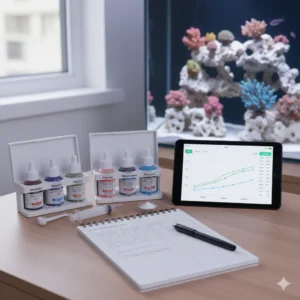
For iron supplement dosing, start conservatively with 1 drop per 25 gallons of water volume, dosed 2-3 times per week. SPS-dominant tanks often benefit more from iron supplementation than soft coral tanks. Iron supplement dosing should always be done in the evening or when lights are off, as iron is quickly consumed by photosynthetic organisms and can oxidize rapidly under intense lighting.
If you detect improved polyp extension or enhanced colors within 1-2 weeks, you are on the right track. However, increasing hair algae or cyanobacteria growth indicates that you need to cut down on either dosing frequency or concentration.
Different coral species respond uniquely to trace elements, which is why understanding proper coral care is essential before aggressive dosing.
Potassium Supplement Dosing: The Metabolism Booster
In a busy reef tank, corals use up potassium fast to fuel their metabolism and keep their cells healthy, but it’s most famous for adding a pop of color to Acropora and other SPS corals. To maintain peak coral health, keep your potassium levels within the 380–420 ppm range. When starting, test weekly to find your tank’s optimal range and slowly transition to monthly check-ins once your levels settle.
While you can add potassium supplement dosing in larger chunks throughout the week, daily doses are more effective in maintaining the rock-solid stability that sensitive corals love.
If your blue Acropora or Montipora display a grey or faded color, it’s often a tell-tale sign that your potassium has dipped below the 380 ppm mark.
NAC Supplement Dosing: Advanced Coral Care
N-Acetyl Cysteine, or NAC, is basically composed of amino acids and functions as a powerful antioxidant to help corals manage oxidative stress around them, like intense lighting, temperature fluctuations, and other environmental factors.
Evidence from research suggests that NAC supplement dosing can help corals cope with stress and even assist in recovery from bleaching events.
NAC supplement dosing protocols are still being refined within the reef community. Current protocols suggest a dose of 5–10 mg per 25 gallons, administered 2–3 times per week. It is most effective during high-stress periods, such as acclimating new arrivals, helping corals bounce back after shipping, or stabilizing a colony that has been stressed by a sudden parameter swing.
Since NAC is a relatively new addition to the reef aquarium toolkit, start with lower doses and monitor how corals respond to it. While some corals show improved polyp extension and robust tissues within days, others may improve subtly over several weeks.
Mastering Dosing: Strategies for a Stable, Thriving Reef
Achieving a world-class reef isn’t just about what you add to the water—it’s about how you add it. If you desire to recreate the vitality and color of corals found in oceans, you should switch from a “reactive” dosing to a consistent, proactive routine.
Manual vs. Automated Dosing
For nano-tanks or systems with just a few corals, manual dosing is a simple, cost-effective way to get started. You test, calculate the ideal amount, and inject it into your tank. However, manual dosing has a “seesaw” effect with parameters rising high when you add the supplement and plunging low until the next dose.
For serious hobbyists, automated dosing pumps make dosing a lot easier and straightforward. These pumps are designed to deliver tiny, precise amounts of supplements every hour and thus eliminate unforeseen chemical swings.
For reef keepers managing complex systems, tools like Reef KG AI Coaching can help interpret trends and fine-tune dosing decisions over time.
The “Test, Adjust, Repeat” Reef Tank Dosing Blueprint
Reef tank dosing issues are one of the common beginner Reef Tank Mistakes, which happens when you overdose on trace elements or skip testing altogether.
Consistency lies at the heart of a successful reef. Stick to a consistent testing schedule and track how much each parameter drops between tests, and then set up dosing to compensate for any losses.
A reef tank that stays consistently near 9 dKH will outperform one that swings between 8 and 11. Stability, not perfect numbers, drives long-term success.
Program your pumps to dose during the early morning or evening when pH naturally dips. This helps buffer the water when your corals are most active.
You can hardly rely on guesswork if you aim to strike the right balance between different nutrients. Reef dosing calculators can help determine what dosing works best for you based on your tank volume and desired parameter ranges.
Bacteria Supplement for Fish Tank – Dosing Supplements For Reef Tanks
While chemical elements get most of the attention in reef dosing discussions, biological supplements are equally, if not more, important. Bacteria supplement for fish tank, whether freshwater or marine, plays a critical role in establishing and maintaining a healthy nitrogen cycle, breaking down organic waste, and creating a stable biological foundation for your entire reef system.
In reef aquariums specifically, beneficial bacteria help convert ammonia to nitrite and then to nitrate (and ultimately to nitrogen gas in low-oxygen zones).
They also compete with pathogenic bacteria, break down detritus, and ingest excess nutrients to keep nuisance algae in check. Quality bacteria supplements contain multiple strains of beneficial microbes specifically selected for marine environments.
When and How to Dose Bacteria Supplement For Fish Tank
Bacterial dosing supplements can speed up the reef cycling process. Instead of 6–8 weeks, a stable biofilter can form in just 2–3 weeks. Follow the dosing instructions during the initial cycle. Most products recommend daily dosing for the first week, then gradually reducing frequency.
In established reef tanks, protein skimming and water changes remove beneficial microbes. Maintenance dosing helps restore this balance. Turn off lights when adding bacteria, or dose while the protein skimmer is temporarily off. This gives bacteria time to settle and colonize surfaces before removal.
Conclusion – Best Dosing Supplements For Reef Tanks
Mastering your reef’s chemistry turns the hobby from constant stress into a rewarding experience. Stable parameters lead to vibrant growth and intense color.
By choosing the right dosing supplements—calcium, alkalinity, and magnesium—along with targeted boosters like potassium and iron, you create a stable environment where corals can thrive and reach their full potential.
Reef tanks aren’t about perfection—they’re about stability. Corals adapt well to steady conditions but struggle with sudden change. Whether you’re dosing manually on a nano-tank or using automated systems for a large display, the key is to test regularly and adjust conservatively based on your tank’s unique needs.
With the right supplements and a consistent routine, you can stop stressing over numbers. Instead, enjoy the vibrant glow and polyp extension that define a healthy reef.
At Reef kg App, we deliver smart dosing and reliable testing tools. These essentials help modern reef-keepers maintain a thriving, colorful reef with confidence.