
Betta fish, also known as fighting fish, enjoy the spotlight for their captivating looks and aggressive personality, but their smaller, equally vibrant cousin deserves just as much attention.
Popularly known as dwarf gourami, these fish come in brilliant blue and red stripes that make them a stunning, often iridescent addition to many community tanks.
Gourami is quite similar to its fellow labyrinth fish in its breathing mechanisms and tendency towards territoriality, making it a feisty relative that requires careful handling. If you are looking to introduce this gorgeous and engaging centrepiece fish to your aquarium, our guide is just for you. In this dwarf gourami care guide, we’ll tell you everything you need to know about their ideal tank setup, diet, compatibility, and how to minimise conflicts for a happy, healthy life.
All About the Dwarf Gourami Freshwater Fish
The Dwarf Gourami (Trichogaster lalius) is a truly fascinating member of the anabantoid family, which is closely related to Betta and Paradise Fish. Its distinguishing features include a classic oblong silhouette and a pair of delicate, whisker-like pelvic fins that help them navigate their environment.
Like its cousin Betta Fish, the Dwarf Gourami is classified as a labyrinth fish. This is because it possesses a specialised, lung-like organ that allows it to gulp oxygen directly from the surface air. This is how it adapts to even shallow, oxygen-deprived waters of its native seas and reef aquariums. Thanks to their small size but colourful appearance, dwarf gouramis easily become the visual centrepiece in freshwater tanks.
Why Dwarf Gouramis Are a Freshwater Favourite?
Dwarf Gouramis are one of the most beloved freshwater fish for good reason. Their vibrant colors, graceful swimming patterns, and relatively peaceful nature make them a stunning addition to any aquarium. Despite their small size, they have big personalities, often interacting with owners and other tank mates in charming ways. They’re also hardy and adaptable, making them suitable for both beginner and experienced aquarists. Whether you’re drawn to their striking blue and red hues or their peaceful presence in a community tank, Dwarf Gouramis bring life, colour, and a touch of personality to freshwater setups, earning their spot as a perennial favourite among fish enthusiasts.
Exploring the Varieties
The regular version of the gourami features a dazzling, light-blue body with bold red vertical stripes. However, selective breeding has produced several gorgeous colour morphs like the powder Blue, an entirely light blue fish with no red striping, and the Flame, with a vibrant red-orange body in sharp contrast to its iridescent blue fins.
Male vs. Female Dwarf Gourami: How to Tell the Difference?
On the surface, Male and female dwarf gouramis may look similar, but they have noticeable differences once you know what to look for.
Male Dwarf Gourami
The male gourami has a brighter appearance with a large, pointed dorsal fin. These features make it the centre of attention in reef tanks, although by nature, they are more territorial than females.
Female Dwarf Gourami
The female Dwarf Gourami is typically distinguished from her male counterpart by her significantly paler, silver-gray coloration. Unlike the vibrant, sharp dorsal fin of the male, the female possesses a more rounded dorsal fin.
She is generally considered more peaceful in temperament, which makes her a desirable addition to community tanks. However, due to less demand for their muted colours, female Dwarf Gouramis are rarely sold in stores, as breeders and retailers focus primarily on the more brightly colored males.
If you’re keeping more than one dwarf gourami, a good idea is to opt for females to minimise aggressive tendencies, but the fact that they are hard to find means males dominate females in numbers.
Dwarf Gourami Types: Colours, Patterns & Varieties
Dwarf gouramis are a beloved lot of fish thanks to their immense variety. If you are into the hobby, here are the most common and stunning dwarf gourami types for you to explore:
1. Neon Dwarf Gourami
- Very bright turquoise and neon-blue body
- Highly reflective in planted aquariums
- Peaceful and easy to care for
These are among the most sought-after dwarf gouramis due to their eye-catching glow.

2. Cobalt Blue Dwarf Gourami
- Deep iridescent blue color
- Minimal striping compared to other types
- Excellent centrepiece fish
The cobalt blue dwarf gourami are generally peaceful, with slightly territorial males that should be kept away from large, aggressive fish. Their color deepens with age, diet, and proper care.

3. Flame Dwarf Gourami Type
- Fiery red-orange body
- Blue hues on the fin edges
- Extremely popular in planted aquariums
This variant exudes a flame-like effect that contrasts with green aquascapes.

4. Honey Dwarf Gouramis
- Soft honey-yellow color
- Smaller and gentler than standard dwarves
- Known for their sweet, timid behaviour
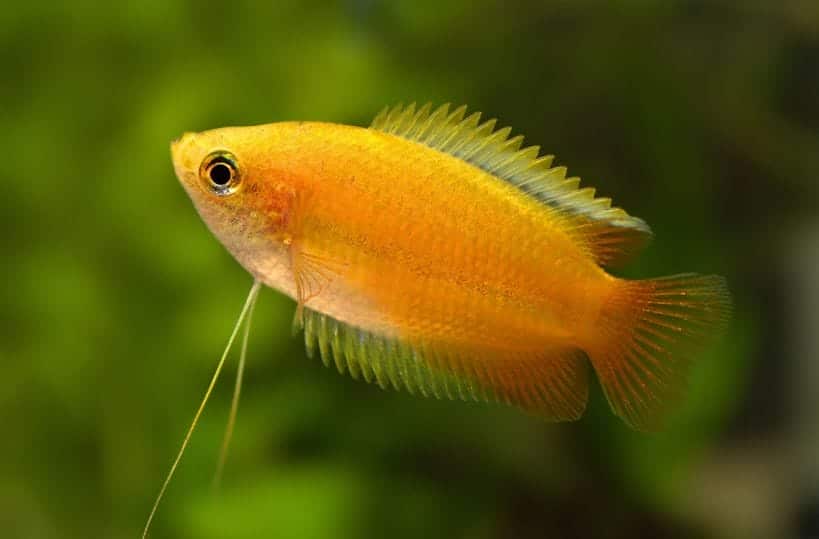
It blends easily with small peaceful fish, nano species, and shrimp in 10-gallon (single) and 15-gallon tanks.
5. Powder Blue Gourami
- Pale blue with subtle silvery undertones
- Suitable for community aquariums
- Hardy and beginner-friendly
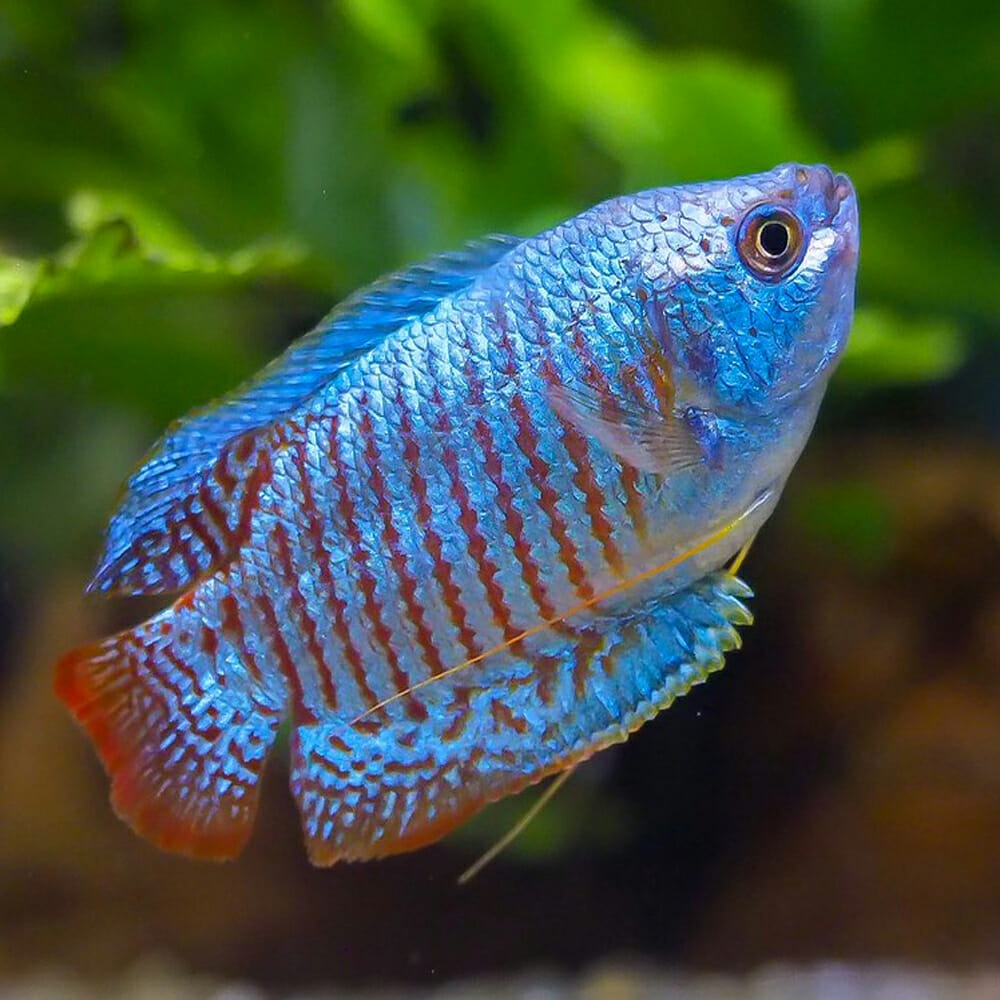
A stunning, beginner-friendly variety with a peaceful to semi-aggressive nature without the intense striping of classic dwarfs.
If you’re curious about other beautiful color morphs and related species, don’t miss our complete guide on 10 Popular Gourami Types to help you choose the perfect gourami for your aquarium.
Dwarf Gourami Tank Setup: Ideal Conditions for Long Life and Care Taking
To keep your gourami happy, you need to recreate the serenity of its original natural habitat, mainly slow-moving water amidst by a dense cover of vegetation. Therefore, the ideal dwarf gourami tank is a minimum of 10 gallons, which can increase to 15–20 gallons, especially for accommodating Pairs, multiple females, and planted aquascapes.
Water Parameters in Freshwater Tanks
Their high resilience means that they can adapt to tanks with pH 6–8, temperatures from 72–82°F (22–28°C), and soft to hard water.
A heater is essential, along with sponge filters, to create a steady water current that supplies essential nutrients to plants while absorbing debris back to the filter.
Aquascaping Tips for Dwarf Gouramis Care
Creating the ideal aquascape for Dwarf Gouramis means mimicking their naturally shaded, shallow habitat to maximise their sense of security and comfort. They thrive best in tanks with dim, dappled lighting, which is most effectively achieved by incorporating plenty of floating plants.
These plants play an essential role in scattering light and providing the necessary overhead cover to safeguard them. Furthermore, floating plants enable males to anchor and construct their delicate bubble nests during breeding periods. This dappled effect can be achieved by using floating plant varieties like Water Lettuce, Frogbit, and Red Root Floaters.
Beyond the surface, the tank should be heavily furnished with natural structures that provide security and break up sightlines. These include aquascaping elements like:
- Tall background plants
- Driftwood
- Caves or rock structures (for hiding and claiming territory)
- Leaf litter (to create a dark, natural substrate)
If you are eager to set up your first-ever tank, check out our Complete Guide to Setting Up a Planted Tank for plant suggestions, layout tips, and easy aquascaping techniques.
Dwarf Gourami Diet: What Do Dwarf Gouramis Eat
Now, let’s come to the question of what to feed the dwarf gourami? In nature, gouramis consume small insects, larvae, and plant matter. When it comes to an aquarium, they rely on a varied diet composed of both sinking and floating foods, mostly because they can swim adeptly at all levels. Since they are voracious eaters, they can consume the share of their slower species and eventually outcompete them.
They thrive on a diverse omnivorous diet that includes staples like High-quality pellets, Mini floating sticks, and Micro granules, as well as Spirulina, Krill flakes, and Beta-carotene foods that help enhance their color. You can treat them to their favorite foods, such as Frozen brine shrimp, Frozen bloodworms, Daphnia, and Mosquito larvae, twice or thrice a week.
Dwarf Gourami Tank Mates – Are Dwarf Gouramis Easy to Live With
Dwarf gouramis are innately peaceful, shy fish, and therefore, you should keep them away from fin nippers or aggressive species to ensure a stress-free environment. Whether or not it can live in a community tank depends on the personality of the individual gourami and its compatibility with fellow tank mates. Some gourami tend to get aggressive during meal times or turn territorial when others trespass into their territory.
For instance, it’s hard for them to coexist with bettas, tiger barbs, or large chichlids that are known to actively hunt. Although they can blend with shrimps, they can come to view newly hatched shrimplets (baby shrimp) and smaller varieties of dwarf shrimp, such as female Cherry Shrimp, as a delicious snack. If you plan to breed ornamental shrimp (like Cherry or Crystal Red), the Gourami will actively cull the population.
The best dwarf gourami tank mates include:
- Corydoras
- Neon tetras
- Harlequin rasboras
- Platies
- Mollies
- Snails
- Shrimp (with caution)
Read our blog on 20 Best Saltwater Aquarium Fish for Beginner Reef Hobbyists to foster harmony in your tank.
Dwarf Gouramis Breeding
Dwarf gouramis are bubble-nest builders, and while breeding them isn’t difficult, it does require the right conditions and a confirmed male–female pair. Males construct a floating bubble nest at the water’s surface, often under floating plants, and court the female with vibrant colouration. Once eggs are released, the male guards and tend the nest until the fry hatch.
Successful spawning typically calls for warm, shallow water, gentle filtration, and high humidity above the tank. Since the full process involves careful preparation and fry-specific feeding, a step-by-step guide can be beneficial.
For the complete setup, breeding tank requirements, and fry-raising instructions, read our full guide: How to Successfully Spawn Dwarf Gouramis (Beginner-Friendly).
How Many Dwarf Gouramis Should Be Kept Together?
Contrary to their reputation as community fish, dwarf gourami are not meant to be kept in groups. The majority of dwarf gouramis are male, which exhibit territorial behaviour like squabbling, chasing, and fin nipping in the company of their counterparts, especially in smaller tanks.
Considering this, the best practice is to place 1 male per tank to minimize conflict. That said, they can pair with other tank mates if they have sufficient space to manoeuvre and hide from one another. If you manage to find female gouramis, you can keep them in groups.
Dwarf Gourami Disease and Health Precautions: What You Must Know
Unfortunately, every type of Dwarf Gourami can be prone to certain illnesses, a risk often heightened when dealing with mass-bred stock. The most serious concern is the deadly Dwarf Gourami Iridovirus (DGIV), a viral infection that has no cure as of now and can be avoided by careful sourcing and buying only from reputable suppliers.
Beyond this incurable viral threat, Dwarf Gouramis, like other fish, are susceptible to bacterial infections (which often present as ulcers and redness) and parasites. The former may present themselves as ulcers or redness, while fish affected by parasites may exhibit “flashing” against tank objects and lose weight drastically.
The best overall strategy for prevention is comprehensive: always quarantine all new fish for two to four weeks, maintain consistently pristine water quality, avoid stress and overstocking the aquarium, and finally ensure you provide a diverse, nutrient-rich diet.
Conclusion: Should You Add a Dwarf Gourami to Your Tank?
If you’re looking for a colorful, hardy, beginner-friendly fish that loves planted tanks, the dwarf gourami is one of the best freshwater choices.
Whether you choose the glowing neon dwarf gourami, the fiery flame dwarf gourami, or the calm honey dwarf gourami, the dwarf gourami can add beauty, personality, and serenity to any freshwater aquarium. By following the tips outlined in this comprehensive guide, you will be set to welcome this charismatic and often feisty relative of the Betta into your home.
Whether you’re building a peaceful freshwater community or exploring nano reef setups, our guide on 10 Best Corals for Nano Tanks showcases beautiful coral options for aquarists who enjoy both sides of the hobby.
Quick FAQs About Dwarf Gouramis
What do gouramis eat?
The diet of Dwarf Gouramis mostly consists of pellets, flakes, algae foods, and frozen/live foods such as bloodworms, brine shrimp, and daphnia.
How big do dwarf gouramis get?
On reaching adulthood, they can grow as long as 3–4 inches in size.
How many dwarf gouramis should be kept together?
It is recommended to keep one male per freshwater tank, while females can adjust in small groups.
Are dwarf gouramis aggressive?
They are generally peaceful by nature, but males may resort to mild territorial behavior when threatened or provoked.
What are the ideal tank requirements and setup for Dwarf Gouramis, including tank size and water flow?
The ideal dwarf gourami tank setup includes a 10–20-gallon tank characterized by a flow of gentle, moderately warm water surrounded by floating plants.
What is the recommended water temperature range for Dwarf Gouramis to thrive?
If dwarf gouramis are to thrive, they must be kept at a consistent temperature of 76–82°F
What is the typical lifespan of a Dwarf Gourami in a home aquarium?
The typical lifespan of the dwarf gourami is between 4–6 years, provided they are given excellent care.