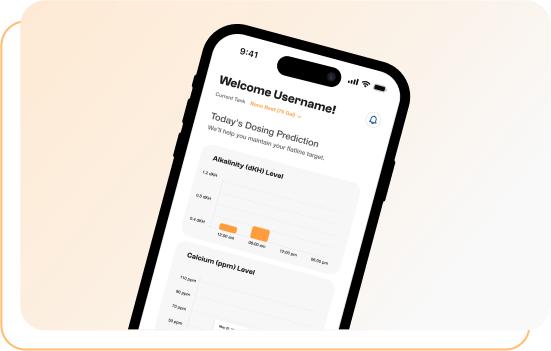
Maintaining stable water chemistry in a reef tank is the difference between thriving corals and a tank crash. Most reef hobbyists simply react to changes when damage has been done, such as after coral bleaching starts or an algae bloom takes over. Whether you’re managing a 200-gallon SPS-dominated display or a 10-gallon nano reef, maintaining stable reef tank parameters remains the biggest challenge in the hobby. Modern reef tank automation with intelligent reef tank alerts predicts issues in advance before visible damage occurs, ensuring robust coral bleaching prevention for your tank.

Traditionally, saltwater aquarium monitoring relies on maintaining handwritten logs and periodic testing. Even experienced reef keepers can miss the subtle shifts in alkalinity, calcium, and pH that lead to coral stress.
Without a reef tank monitoring system
Reef KG’s reef tank monitoring system acts as a 24/7 guardian for your saltwater aquarium. Instead of reacting to coral bleaching or tissue recession, you receive early warnings when parameters begin trending outside safe ranges. This approach to coral reef tank maintenance shifts you from reactive to proactive.


Most aquarium monitoring apps bombard you with notifications, leading to “alarm fatigue.” This can make you ignore even critical ones. Reef KG’s reef tank alerts system uses intelligent filtering to distinguish between routine maintenance reminders and true emergencies that threaten coral health.
Get an instant numerical score (0-100) indicating your reef tank stability:
90–100 (Optimal): Peak parameters for SPS growth and high-end coloration.
75–89 (Stable): Safe conditions suitable for LPS and soft coral colonies.
60–74 (Intervention Needed): Minor imbalances in reef tank water chemistry; action required within 48 hours.
Below 60 (Critical): High-risk chemistry imbalance; immediate intervention needed for coral bleaching prevention.
This scoring system analyzes multiple reef tank parameters simultaneously, catching complex interactions that single-parameter alarms miss.
Reef tank automation isn’t just about water chemistry—it’s also about coral reef tank maintenance discipline. Reef tank crashes often happen because maintenance tasks get postponed.
Capture Issues Immediately: Notice salt creep on your dosing pump, but can’t clean it right now? Log it instantly in the aquarium monitoring app with a photo and priority level.
Organized Maintenance Queue: All deferred coral reef tank maintenance tasks appear in a prioritized list showing:
Historical Maintenance Records: Build a complete log of every water change, parameter test, equipment cleaning, and coral addition. This history becomes invaluable for coral bleaching prevention when troubleshooting mysterious issues months later.


Nano reefs (under 30 gallons) are hyper-sensitive. In a 10-gallon system, a single dead snail or 0.5 gallons of evaporation can increase salinity and ammonia to lethal levels in hours. Reef tank automation acts as a vital safety net for nano keepers; it provides reef tank alerts the moment alkalinity drops from 9 to 7.5 dKH overnight, long before Acropora frags fall prey to tissue recession.
SPS corals require alkalinity stability within ±0.5 dKH. A monitoring system catches a drift of 0.2 dKH in real-time, allowing for “micro-adjustments” that are impossible with manual weekly testing.
Traditional alarms trigger when you hit a “danger number” (e.g., pH below 7.8). Smart alerts recognize the velocity of change. If your pH is 8.1 but dropping 0.1 points every 30 minutes, the app alerts you before you hit the danger zone
While experienced reefers can maintain reef tank stability manually, reef tank automation can be especially helpful for beginners. Automated reef dosing prevents the dosing mistakes that lead to tank crashes, while reef tank alerts keep you updated about your tank’s internal conditions.