
Algae is one of the most common—and frustrating—problems reef tank owners face. While some algae are natural and even beneficial, uncontrolled growth can quickly ruin the appearance of your aquarium, stress corals, and throw your entire reef system out of balance.
The good news? Algae problems are fixable. You don’t need magic chemicals; you just need the right reef strategy.
This detailed guide covers why algae grows, the different types of algae, and step-by-step methods to get rid of algae in a reef tank permanently.
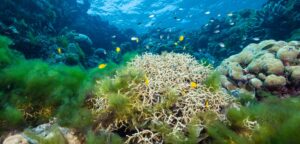
Why Algae Grows in Reef Tanks?
Algae growth is almost always a symptom, not the root problem. Algae thrives when your tank has excess nutrients and favorable conditions. Understanding the underlying causes is essential for long-term control rather than just treating the visible growth.
The Main Causes of Algae in Reef Aquariums
- High nitrates (NO3): Nitrates accumulate from fish waste, uneaten food, and decaying organic matter. While some nitrate is normal in a reef system, levels above 10-20 ppm create ideal conditions for nuisance algae like hair algae and cyanobacteria. Regular testing and maintaining levels closer to 1-5 ppm will favor coral growth over algae.
- High phosphates (PO4): Phosphates enter your system through food, tap water, and even some additives. Even trace amounts (0.03+ ppm) can fuel persistent algae blooms. Many successful reef keepers aim for undetectable phosphate levels or keep them below 0.03 ppm using chemical filtration, controlled feeding, or nutrient export methods.
- Excess lighting or incorrect light spectrum: Too much light intensity or running lights for extended periods (more than 8-10 hours daily) provides algae with energy to photosynthesize and outcompete corals. Additionally, older bulbs or LEDs with excessive yellow/green spectrum can favor algae growth. Finding the right photoperiod and spectrum for your specific corals while limiting algae opportunity is a delicate balance.
- Overfeeding fish: Generous feeding means more waste production and uneaten food decomposing in your system. Fish should consume all food within 2-3 minutes. Excess feeding is one of the quickest ways to spike nutrient levels and trigger algae outbreaks.
- Poor water flow: Stagnant areas with low flow allow detritus to settle and decompose, creating nutrient hotspots where algae colonies establish. Proper circulation prevents dead zones, keeps nutrients suspended for filtration removal, and makes it harder for algae to attach and grow.
- Infrequent water changes: Regular water changes (10-20% weekly or bi-weekly) dilute accumulated nutrients and replenish trace elements. Skipping water changes allows nutrients to build up gradually, creating an environment where algae thrives while coral health declines.
- Lack of proper clean-up crew: A balanced clean-up crew of snails, hermit crabs, urchins, and herbivorous fish helps consume algae before it becomes established. Different species target different algae types—emerald crabs for bubble algae, turbo snails for film algae, tangs for hair algae. Without biological control, you’re fighting a constant manual battle.
Common Types of Algae in Reef Tanks – What Type of Algae Can Harm Your Reef Tanks?
Identifying the type of algae helps you choose the right solution to protect and set up your reef tank clearly.
-
Green Hair Algae (GHA)
- Long, stringy, bright green
- Grows on rocks, sand, and equipment
- Caused by high nutrients and strong lighting
-
Brown Algae (Diatoms)
- Fine brown dust on sand and glass
- Common in new tanks
- Fueled by silicates
-
Cyanobacteria (Red Slime Algae)
- Red, purple, or dark slimy sheets
- Traps air bubbles
- Caused by low flow and nutrient imbalance
-
Bubble Algae
- Green bubble-like sacs
- Spreads rapidly if popped
- Thrives in nutrient-rich tanks
-
Film Algae
- Thin green film on glass
- Usually harmless but unsightly
Step-by-Step Process: How to Get Rid of Algae in a Reef Tank?
Step 1: Test and Control Nutrients
Algae feeds on nitrates and phosphates. Testing is non-negotiable if you want to understand what’s fueling your algae problem and track your progress.
Ideal Reef Tank Levels:
- Nitrates: 1–10 ppm (some reefers go even lower, 1-5 ppm)
- Phosphates: 0.03–0.1 ppm (many target undetectable to 0.03 ppm)
How to Lower Nutrients of your reef tank:
- Perform regular water changes (10–20% weekly) Water changes are your most reliable reef tool for exporting nutrients while replenishing trace elements. Consistency matters more than volume—smaller, frequent changes are better than large, sporadic ones. Use a quality salt mix and match your salinity to avoid stressing corals.
- Use RO/DI water only Tap water often contains phosphates, nitrates, silicates, and heavy metals that directly feed algae. An RO/DI system removes these contaminants, giving you a clean slate. Always test your RO/DI water periodically to ensure your filters and membrane are functioning properly—TDS should read 0-1 ppm.
- Reduce feeding amounts Most reef tanks are overfed. Fish should consume all food within 2-3 minutes, and any sinking food should be minimal. Consider feeding smaller portions multiple times per day rather than one large feeding, or skip feeding entirely 1-2 days per week. Remember that corals don’t require daily feeding like fish do.
- Rinse frozen food before feeding Frozen food packages contain nutrient-rich juices and small particles that immediately dissolve into your water column. Thaw frozen food in a small container or net, rinse it with RO/DI water, then feed only the solid pieces. This simple step can significantly reduce phosphate input.
Additional nutrient control methods:
- Add or upgrade your protein skimmer to remove dissolved organic waste before it breaks down
- Use chemical filtration like GFO (granular ferric oxide) for phosphate removal or carbon dosing to feed beneficial bacteria
- Employ a refugium with macroalgae like chaeto to compete with nuisance algae for nutrients
- Consider a media reactor for controlled chemical filtration
- Maintain your mechanical filtration—clean or replace filter socks, sponges, and pads regularly to prevent them from becoming nutrient sources
The key is to reduce nutrient input while increasing nutrient export, creating an environment where corals thrive but algae struggle to gain a foothold.
Step 2: Improve Filtration to Get Rid of Algae
Proper filtration removes excess waste before algae can use it as fuel. Think of your filtration system as your first line of defense—it intercepts nutrients and organic compounds before they have a chance to break down and feed unwanted growth.
Key Filtration Methods:
Protein skimmer: Removes organic waste A quality protein skimmer is arguably the most important piece of equipment for nutrient control. It removes dissolved organic compounds (proteins, amino acids, fatty acids) from the water column before they decompose into nitrates and phosphates. Size your skimmer appropriately for your tank volume—going slightly oversized is better than undersized. Clean the collection cup every few days and the neck weekly to maintain optimal performance. A well-tuned skimmer should produce dark, thick skimmate rather than watery tea-colored liquid.
Mechanical filtration: Filter socks or sponges (clean weekly) Mechanical filtration traps solid waste particles—uneaten food, detritus, fish waste—before they break down in your system. Filter socks (100-200 micron) or foam sponges catch debris as water flows through your sump. The critical part: clean or replace them at least weekly, ideally every 2-3 days. Dirty mechanical filtration becomes a nutrient factory, doing more harm than good as trapped waste decomposes in place. Keep spare filter socks on hand and rotate them—rinse used ones in hot water (no soap), let them dry completely, then reuse.
Biological filtration: Live rock and beneficial bacteria Live rock provides massive surface area for beneficial nitrifying bacteria that convert toxic ammonia to nitrite, then to less harmful nitrate. Established live rock also houses countless microorganisms that break down organic matter and compete with algae for nutrients. Ensure adequate live rock (1-2 pounds per gallon) with good porosity. Don’t overclean your live rock—gentle flow and your clean-up crew should handle maintenance. Consider adding bacterial supplements during tank cycling or after medication use to replenish populations.
Step 3: Optimize Lighting
Light doesn’t cause algae alone—but it fuels it. Algae are photosynthetic organisms that convert light energy into growth, so your lighting schedule and spectrum directly impact how well algae can thrive versus your corals.
Reef Tank Lighting Tips to Avoid Algae:
- Limit lighting to 8–10 hours per day Longer photoperiods give algae more opportunity to photosynthesize and outpace coral growth. Most successful reef tanks run 8-10 hours of full spectrum light, with some running ramping schedules that gradually increase and decrease intensity to simulate natural sunrise and sunset. New tanks should start with shorter photoperiods (6-7 hours) and gradually increase as the system matures.
- Avoid old bulbs (replace annually if not LED) Metal halide and T5 fluorescent bulbs degrade over time, shifting their spectrum toward yellow and green wavelengths that algae love while coral-friendly blue spectrum diminishes.
- Reduce excessive white light While white light makes your tank appear natural and showcases fish colors beautifully, too much white (especially in the yellow-green range of 550-600nm) promotes algae growth more than coral coloration. Most reef tanks benefit from a blue-heavy spectrum (14,000-20,000K appearance) with just enough white to view your tank naturally. If fighting algae, dial back white channels and increase blue—your corals will respond better, and algae will struggle.
- Use reef-appropriate LED spectrum Modern LED fixtures offer programmable control over individual color channels. Target a spectrum heavy in violet (390-420nm), royal blue (440-460nm), and some blue (465-485nm) with minimal cyan, green, yellow, and red. These wavelengths penetrate water effectively and drive coral photosynthesis while being less favourable for most nuisance algae.
Step 4: Increase Water Flow of A Tank
Dead spots allow detritus and algae to settle. Stagnant water creates nutrient-rich zones where algae colonies establish themselves and become difficult to remove, while also preventing corals from receiving the nutrients and gas exchange they need.
- Add or reposition powerheads Most reef tanks benefit from multiple powerheads positioned at different angles to create comprehensive circulation. A general guideline is 10-20 times your tank volume per hour in total flow for mixed reefs, with SPS-dominant tanks often requiring 20-40+ times turnover. Don’t rely on your return pump alone—it’s designed for filtration, not primary circulation.
- Aim for random, turbulent flow Nature provides chaotic, multidirectional flow patterns rather than constant laminar streams. Modern wavemakers and controllable powerheads offer modes that randomize flow patterns—pulse waves, alternating patterns, gyre flow, and nutrient transport modes. These programs constantly change water direction and intensity, preventing algae from adapting to consistent conditions while better simulating reef environments.
- Ensure no area of the tank is stagnant Walk around your tank and observe from all angles. Look behind rockwork, in corners, and under overhangs. Drop a small piece of food or observe suspended particles—they should move throughout the entire tank, not settle in specific areas.
How to Prevent Algae from Coming Back
Once algae is under control, prevention is key. The real work isn’t eliminating an outbreak—it’s maintaining the conditions that keep algae from returning while allowing your corals and reef ecosystem to thrive long-term.
Long-Term Algae Prevention Tips
Stick to a consistent maintenance schedule Consistency is everything in reef keeping. Create a written schedule and follow it religiously: water changes every 7-14 days, filter sock cleaning every 2-3 days, skimmer cup cleaning every 3-5 days, glass cleaning as needed. Major problems develop when maintenance becomes sporadic—missing a few water changes allows nutrients to creep upward, and dirty mechanical filtration becomes a nutrient source.
- Test water weekly: Regular testing catches problems before they become visible. Test nitrates, phosphates, alkalinity, calcium, and magnesium weekly during the first 6-12 months, you can use a reef magnesium calculator or calcium dosing app for this purpose then bi-weekly once your system is stable and you understand its consumption patterns.
- Don’t overstock fish: Every fish adds bioload from Puffer fish to Gouramis. Waste production that becomes nutrients. Research adult sizes and temperament before purchasing, and follow conservative stocking guidelines: roughly one inch of fish per 4-5 gallons for beginner systems, less for heavy waste producers like tangs. Overstocked tanks require aggressive filtration and maintenance to stay balanced, and any lapse quickly results in nutrient spikes.
- Feed responsibly: Feed only what your fish consume in 2-3 minutes, once or twice daily. High-quality foods with lower ash content and better digestibility mean less waste. Vary your foods—pellets, frozen mysis, frozen brine shrimp enriched with spirulina, nori sheets for herbivores—to provide complete nutrition while preventing overfeeding any single food type. Consider fasting your fish one day per week; it won’t harm them and reduces weekly nutrient input by 15%.
Common FAQs Regarding How to Get Rid of Algae
Is Some Algae Normal in a Reef Tank?
Yes. A small amount of algae is healthy and expected.
- Light film algae = normal
- Coralline algae = beneficial
- Explosive algae growth = problem
The goal is balance, not a sterile tank.