
Most reef keepers lose corals not because they are low on luck but because of the cumulative effect of dosing errors that remain hidden from view. If you’re struggling to keep alkalinity stable or constantly correcting calcium swings, a reef tank dosing calculator can get rid of random errors and prevent costly coral loss.
Everything may look fine on the surface, but the real damage is lurking deep within reef waters, be it a gradual alkalinity drift or a calcium imbalance. A professional reef dosing calculator online doesn’t simply do the maths for you; it helps you anticipate changes instead of merely reacting to them.
In this guide, we’ll break down why precise dosing can make or break your tank, how to use a dosing calculator effectively, and provide actionable tips for reef tank stability.
Why Accurate Dosing Is Critical for Coral Health
Corals are living beings that rely on a delicate balance of nutrients and minerals to build their skeleton and maintain tissue health. That process, also known as calcification, depends on balancing reef tank chemistry
If your reef aquarium supplement dosing is off, it can lead to:
- Coral bleaching or tissue recession
- Algae outbreaks
- Reduced skeletal density and inhibited growth
The “Big Three”: Why You Need a Specific Calculator for Each
Stable parameters are the holy grail of reefing. Using an alkalinity dosing calculator or a calcium dosing calculator reef tool ensures you aren’t just dumping chemicals into a glass box.
Alkalinity (dKH)
It offers a buffering force for pH and supplies carbonate ions required to build the skeletal structure of corals. The recommended alkalinity range is 8–9 dKH; if it drops below that, it can slow down coral growth, whereas a spike triggers SPS tip burning.
Calcium (ppm)
With an ideal range of 400–450 ppm, calcium is the main building block for coral skeletons. Too low calcium weakens skeletons, whereas too high calcium prompts dissolved calcium to precipitate out of solution. This turns your water cloudy and forms a white calcium carbonate crust on your equipment’s surface.
Magnesium (ppm)
Magnesium acts as the stabilizer that binds calcium and alkalinity in solution. If your magnesium dosing is not consistently adequate, both calcium and alkalinity are likely to crash no matter how often you correct them.
What distinguishes experienced hobbyists from novices is that they pursue stability rather than specific numbers. They realize that a consistently stable 8 dKH alkalinity is safer for corals than one that constantly swings between 7.5 and 9.0 dKH.
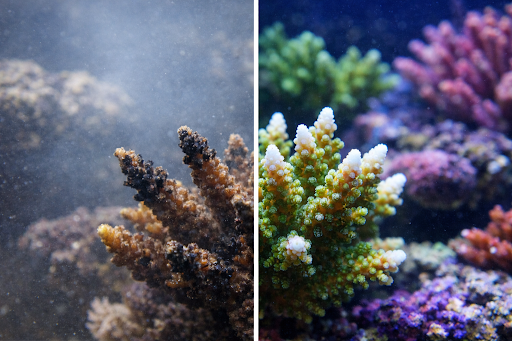
“Healthy SPS coral in a stable reef tank”
4 Dosing Mistakes That Quietly Destroy Reef Tanks
Even the most dedicated reef keepers can fall into the trap of perfecting dosing. Since reef tanks function as a closed ecosystem, this means that even small errors can snowball into major disasters.
Before using a reef chemistry app, it’s worth exploring 4 reef dosing calculator mistakes that can cause parameter crashes in otherwise well-maintained tanks.
1. Estimating Water Volume Instead of Calculating It
Most hobbyists estimate their volume based on the tank’s size. In doing so, they forget a crucial fact that 50 lbs of live rock and a deep sand bed can displace 20% of your water quantity.
The Risk: Suppose that you calculate dosing for 100 gallons when you actually have 80 gallons of water in your tank. This means that you are overdosing by an excess of 25%. In a nano reef, that’s not just a minor mistake, but a grave error that threatens the entire system.
2. Correcting Individual Readings Instead of Tracking Trends
The immediate reaction to a low alkalinity reading is to inject a “corrective” dose. This exposes your corals to a chemical seesaw situation with fluctuating parameters that leaves the corals stressed.
The Smart Way: A dosing calculator doesn’t track a single snapshot at a given point in time. It analyzes trends to determine the velocity of change. Stability isn’t about achieving specific numbers; it’s about staying
3. Using a Static Dosing Schedule as Your Tank Grows
Your reef is a living, breathing entity. As your corals encrust and your fish grow, their metabolic “burn rate” increases. A manual dosing schedule that worked in January will no longer work by March. If you fail to account for Daily Draw, the parameters are likely to slowly drift into the danger zone, as your routine cannot sustain coral growth.
4. Ignoring Magnesium Until Something Breaks
Many hobbyists focus solely on the “Big Two” (Calcium and Alk) while sidelining Magnesium. If the Magnesium levels are not in sync, your Calcium and Alkalinity are forced out of solution, forming white crusts on your heaters and seizing your expensive wavemakers.
A reef tank water chemistry calculator helps maintain the perfect ratio between this chemical trio to ensure maximum bioavailability of nutrients.
How to Use a Reef Tank Dosing Calculator for Stable Parameters
A reef tank dosing calculator is one of the most powerful tools for maintaining stable reef tank parameters. Here’s a series of steps that you can follow to prevent rapid chemical changes in your saltwater reef aquarium:
Step 1: Measure Your Actual Water Volume
Don’t use the volume specified by the tank manufacturer. Any tank consists of rockwork, sand, and equipment that displaces water. This can cause dosing estimates to vary by 5–10%, which can be harmful to sensitive corals.
Pro Tip: Use your tank’s dimensions and subtract the estimated displacement
Step 2: Record Current Water Parameters
Test your tank for key parameters to get a precise idea about the current state of your water chemistry.
- Alkalinity (dKH)
- Calcium (ppm)
- Magnesium (ppm)
When you input these values into the calculator, it recommends precise doses that reflect your tank’s real conditions.
Step 3: Set Your Target Parameters Based on Your Coral Type
The table below shows recommended stable reef tank parameters for different coral types.
| Parameter | SPS Tank | LPS Tank | Mixed Reef |
| Alkalinity | 8–9 dKH | 8–10 dKH | 8–9 dKH |
| Calcium | 400–450 ppm | 400–450 ppm | 400–450 ppm |
| Magnesium | 1300–1400 ppm | 1250–1350 ppm | 1250–1350 ppm |
Maintaining dosing within these ranges ensures reef tank stability to enable corals to grow optimally.
Step 4: Determine Your Tank’s Daily Consumption Rate
Hobbyists often overlook how much their tank actually consumes. A good way to find this out is to test alkalinity for 7 consecutive days at the same time each day.
- Calculate the average daily drop, which is your tank’s “burn rate”.
- Input this number into the dosing calculator
This helps you choose just the right dose of supplements that is best for your tank, without the risks of overdosing or underdosing.
Step 5: Follow Incremental Adjustments
The calculator doesn’t just give a single dosing volume: it provides a step-by-step way to manage dosing to prevent shocking your corals.
- Adjust no more than 10% of a parameter in 24 hours.
- Divide doses into equal intervals throughout the day instead of dosing at once.
- Monitor trends weekly to fine-tune adjustments over time.
How a Reef Chemistry App Simplifies Maintenance
Dosing remains a key challenge for hobbyists, and they eventually make assumptions about tank volume, coral consumption, or water chemistry trends. The Reef Tank Dosing Calculator from Reef KG is designed to solve all kinds of dosing -related problems. It simplifies dosing in the following ways:
- Calculates the exact supplement volume that your tank needs by factoring in displaced water from rocks and sand.
- Recommends how to make incremental adjustments based on current water chemistry, hence preventing overdosing.
- Tracks trends over time. This allows you to anticipate any changes in coral consumption and bioload before they strike.
- Aligns dosing with your tank’s ideal baseline. This encourages corals to grow consistently while maintaining vibrant coral coloration.
In short, it lets you move from reactive dosing to proactive reef maintenance where you control your reef’s internal conditions.
Pro Strategy: Use our reef dosing calculator online to determine your tank’s daily “burn rate.” Test alkalinity for 7 consecutive days, calculate the average drop, and input that into the calculator for perfect daily dosing.
Understanding the Calcium-to-Alkalinity Relationship
Corals consume Calcium and alkalinity in a fixed ratio. The general rule is that for approximately every 1.0 dKH of alkalinity consumed, 6–7 ppm of calcium is used. This means that alkalinity and calcium consumption rates are proportional to one another, and your dosing strategy should reflect that.
If calcium exceeds 500 ppm, it begins forcing alkalinity out of solution. This destabilizes the chemistry that shows as a drop in your alkalinity readings, not because corals consumed it. Similarly, if the alkalinity goes above 12–13 dKH, it triggers calcium precipitation.
That’s why it is important to check the Ca-to-Alk ratio first before adjusting either parameter separately. Otherwise, one falls into the error of assuming any discrepancy as a result of calcium when alkalinity is actually causing instability. Reef KG’s water chemistry feature helps in monitoring this ratio continuously, so as to flag imbalances before they aggravate.
Final Thoughts
Precision dosing lies at the heart of reef tank parameter control. For hobbyists, the Reef Tank Dosing Calculator offers a handy tool to switch from guesswork to data-driven, stable maintenance that keeps corals healthy, colorful, and stress-free.
Stop reacting and start calculating precise doses for your tank to turn your hobby into a true success. Try the Reef Tank Dosing Calculator Today.
FAQ Section
Q1: How often should I use the dosing calculator?
A calculator can be used whenever you wish to test your water parameters or observe any significant parameter drift. If you have a new tank, it’s recommended to test daily for the first 4–6 weeks.
Q2: Can I override the calculator’s recommendations?
Yes. The calculator suggests, based on actual data, but it’s ultimately up to you to implement whichever dosing decisions you find best for your tank.
Q3: Does it work for nano tanks?
Our calculator works for tanks of all sizes. Simply enter your true water volume, which includes the amount lost by rock and sand displacement, to get precise dosing estimates for your tank size.