
If you are passionate about aquariums or ready to advance beyond a freshwater aquarium, then a saltwater aquarium is the perfect way to get started. The idea of owning a saltwater fish tank fascinates many lifelong aquarists, but building and maintaining one requires a thorough understanding of how seawater ecosystems function and careful planning.
While social media and online forums provide a great opportunity to connect with fellow aquarists and learn from their experiences, the influx of information can be quite overwhelming for beginners. Most expect straightforward answers to the most crucial question, “What do I need for a saltwater fish tank setup?
In this guide, we aim to provide a step-by-step method for setting up a saltwater fish tank, including the saltwater fish tank kit and methods that will give you the best results.
Choosing the Right Saltwater Aquarium Size?
New reefkeepers often mistakenly assume that starting small is the easy way out. No wonder they are drawn to nano tanks (10–20 gallons) as an appealing and budget-friendly option, but it’s only a matter of time before they face the real challenges.
Ideally speaking, the best tank size for beginners should lie between 30–50 Gallons, as this range yields a stable internal environment where all vital parameters like salinity, temperature, and nutrients are balanced enough to promote optimum growth. A bigger tank further extends the type and number of livestock you can add, so that you can enjoy a diverse variety of marine life without space limits.
The smaller the saltwater fish tank, the more prominent the changes in water chemistry. In larger volumes, the changes aren’t as noticeable when food waste accumulates or water evaporates, whereas in nano tanks, the effects are felt more dramatically. Since there is less chance of rapid parameter swings, it makes maintenance stress-free while giving upcoming reefers a chance to learn without major disruptions.
How Many Fish Can Be Kept in a 75-Gallon Saltwater Tank?
A 75-gallon tank is often considered the ideal minimum size for a full-fledged reef or fish-only saltwater fish tank. It offers significantly more stability and room for active swimmers compared to a 55-gallon tank. However, the specific number of fish still depends heavily on the species you choose.
General Guidelines
There is no fixed number, but if you select small to medium-sized, appropriate fish, you can typically stock:
- Small/Nano Fish (e.g., Gobies, small Wrasses): You could safely accommodate 10 to 15 of these smaller fish.
- Mixed Community (Most Common): A good balance is usually around 7 to 10 fish, including one or two medium-sized feature fish (like a small Tang or a Dwarf Angelfish).
- Large or Active Fish: If you introduce one very active or large fish (like a Yellow Tang), that single fish will take up the bioload and swimming room of 4-5 smaller fish, thus reducing your total count substantially.
If you are wondering how many saltwater fish are in a 55-gallon tank, it’s best to follow the old rule of thumb: 1 inch of fish per gallon. This amounts to a maximum of 27-55 inches of adult fish length in a 55-gallon tank.
Essential Equipment in Saltwater Fish Tank Kit For Your Aquarium
Apart from the natural ecological processes that depend on exotic saltwater fishes, saltwater tanks are built on the synergy between external factors like filtration, biological balance, and proper lighting. We have rounded up the complete equipment list that is included in a saltwater fish tank kit.
1. RO/DI Water System
Tap water contains minerals like chlorine, metals, ammonia, nitrate, and phosphate, which can provide a source for algae blooms and coral stress.
You can either purchase ready-made RO/DI water from a local fish store or use an RO/DI unit at home. This is necessary to ensure your saltwater aquarium setup is composed of highly pure water free from toxins or other unwanted substances.
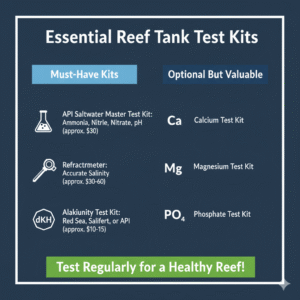
2. High-Quality Salt Mix + Hydrometer/Refractometer
You can create saltwater at home by yourself by mixing RO/DI water with marine-grade salt that comes with a salinity in the range between 1.024–1.026 SG.
Using a refractometer can help you determine the exact salinity of your mixture to avoid excesses in the composition.
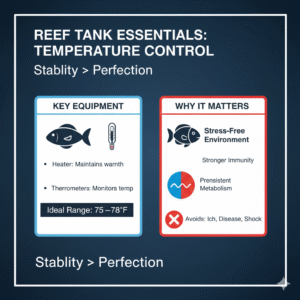
3. Heater + Thermometer
Most tropical freshwater fish and corals are optimised for specific temperature ranges, which means any deviations can greatly disrupt the natural metabolic processes.
Your tank’s temperature shouldn’t rise or fall below the range 75°F–78°F to minimise stress for marine life and promote their wholesome growth.
4. Protein Skimmer
This is one of the most essential pieces of reef tank equipment. A protein skimmer for reef tanks has a proactive role to play by removing organic waste before it breaks down into ammonia or nitrate. Getting rid of dissolved organics and DOD helps improve water clarity and maximises the light penetrating corals.
It also facilitates the gas exchange process that keeps oxygen levels stable and prevents major drops in pH that might occur with the breakdown of acidic compounds. Finally, removing organic products keeps nitrates in control, as too high levels can boost algae growth and threaten corals.
5. Filter or Sump System
Whether it’s a freshwater or marine tank, a robust filtration system is pivotal to keep the water clean, clear, and biologically stable. For beginners, Hang-On-Back (HOB) Filters are the best choice as they are not only straightforward to set up and operate but also affordable and easy to maintain.
In case of advanced setups, Sumps are a better way to benefit from increased volume and space for filter media that aids superior filtration. They also provide a discrete location to house essential equipment like protein skimmers, heaters, and return pumps to minimise clutter and improve aesthetics.
6. Powerheads / Wavemakers
Powerheads and wavemakers are designed to simulate the strong, turbulent currents found in natural oceans within the confines of a saltwater fish tank or aquarium. The recommended flow rate is 10–20x your tank volume per hour, so a 100-gallon tank might need 1000-2000 gallons per hour (GPH) of total flow.
Since corals are sessile (fixed in place) organisms, they rely on a strong, random flow to get food particles (like plankton, micro-fauna, or dissolved organic matter), essential dissolved nutrients, as well as oxygen to sustain their health.
7. LED Lights for Coral Fish
Coral reef animals, particularly those housing symbiotic algae called zooxanthellae, convert light energy into sugars that feed the coral. Without the right light, corals will slowly starve, lose their vibrant colours, and ultimately perish.
Choose a “full-spectrum” light fixture to ensure corals are exposed to a wide range of wavelengths for photosynthesis. Not all corals require the same intensity of light, so use a source with adjustable lighting to “tune” the light to the specific needs of the corals.
8. Live Rock + Sand Ornaments and Essentials
Rock and sand aren’t just decorative elements of aquascaping in your reef tanks; they are the very “biological heart” of the saltwater fish tank. They both provide an immense amount of surface area for nitrifying and denitrifying bacteria to colonise. These bacteria convert nitrate into nitrogen gas, which contributes significantly to overall biological filtration and
Moreover, live rock creates natural crevices, caves, and overhangs that offer hiding spots for fish, invertebrates, and even corals.
How much do you need?
- 1–1.5 lbs of live rock per gallon
- 1–2 inches of sand for most tanks
How to Set Up a Saltwater Fish Tank Step-by-Step
Now that you know the saltwater reef equipment, here’s how to bring it all together:
Step 1: Prepare the Tank & Equipment
Start by rinsing the saltwater fish tank to wipe off residues, dust, or other contaminants. Avoid soap as residues can be highly toxic to marine life, and then move to position your stand firmly at a level it can bear the weight of the tank.
After that, install the equipment while ensuring power outlets are safely elevated using drip loops on all power cords to prevent water from running down the cord into the outlet.
Step 2: Add RO/DI Water + Salt Mix
If mixing directly in the tank, add your RO/DI water first. Then, slowly add the salt mix while circulating the water with a powerhead or pump. Let it dissolve fully before adjusting salinity. Do not add dry salt directly to a tank with live animals!
Step 3: Add Live Rock & Sand
Build your rock structure directly on the glass bottom of the tank to prevent the rock from shifting or collapsing later. Once your rockscape is stable and finalised, gently add your live sand. This foundational structure determines flow, coral placement, and aesthetics.
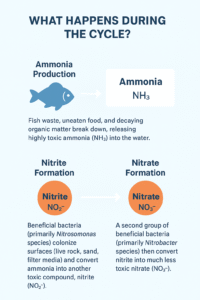
Step 4: Start the Nitrogen Cycle (Takes 4–6 Weeks)
A bonus tip: Never add fish before your tank is cycled.
Best Beginner Saltwater Fish for Your First Saltwater Fish Tank?
Once you have your saltwater reef tank setup ready, the next step is to choose beginner-friendly fish that won’t overwhelm your budding saltwater fish tank or threaten your emerging coral garden. For a full breakdown of top beginner species, check out our guide: 20 Best Saltwater Aquarium Fish for Beginner Reef Hobbyists.
Here are the top picks for you to consider:
- Ocellaris Clownfish: They are incredibly hardy, colourful, and peaceful towards other tank mates.
- Royal Gramma: This vibrant purple/yellow species makes a stunning focal point, along with being reef-safe.
- Firefish Goby: These slender, stunning fish with their red, orange, and white fins are captivating to look at, with a shy nature.
- Bangaii Cardinalfish: Apart from being visually unique with their striking black and silver stripes and elegant fins, they easily feed on most prepared foods. They are generally peaceful and relatively slow-moving, making them a calm addition.
- Chromis: These small, iridescent schooling fish add fantastic movement and shimmer to the tank, especially when kept in groups of 3-5+.
When your saltwater aquarium is in the early stages, it’s hard to resist the temptation to include visually striking fish or those with unique characteristics, but such ill-informed choices can make your journey as a new reef-keeper all the more challenging. It’s best to avoid species like:
- Mandarins
- Butterflyfish
- Triggerfish
- Large angelfish
Starting with the recommended hardy and reef-safe species would give beginners much-needed experience and a chance to enjoy the beauty of their tank while seeing it mature.
Maintenance: How to Keep Your Saltwater Aquarium Healthy
Consistent maintenance is what separates thriving reef tanks from struggling ones. Here are some essential tips on how to take care of a saltwater fish tank:
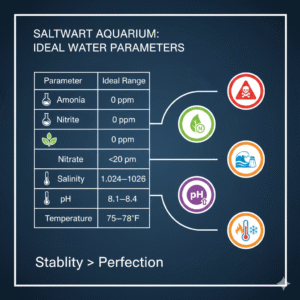
Weekly Tasks:
- Check key water parameters (ammonia, nitrite, nitrate, salinity).
- Wipe down aquarium glass.
- Replenish evaporated RO/DI water.
Monthly Tasks:
- Perform a 20–25% water change.
- Swap out carbon or other filter media.
- Clean pumps and protein skimmers.
Conclusion – The Right Saltwater Fish Tank Kit
Starting a saltwater fish tank is not just about assembling a tank’s components; it’s about providing a sound foundation for a thriving marine ecosystem. Your first saltwater fish tank setup
may not be as perfect as you’d expect it to be, and you might end up with algae blooms or loss of a few fish.
Ready to begin your saltwater aquarium journey? Join the ReefKG community and transform your reefing experience with AI-powered dosing and monitoring tools to make reefing truly rewarding.
FAQs: Saltwater Fish Tank Kit Queries for Beginners
1. What do I need for a saltwater fish tank?
2. How long does it take to cycle a saltwater tank?
Most tanks take 4–6 weeks to fully cycle nutrients, so make sure to add livestock only once ammonia and nitrite remain at 0 ppm.
3. How much does a saltwater aquarium setup cost?
A beginner setup typically costs $780–$2,000, although the exact cost depends on the size of the tank and the equipment. The livestock that you choose to include within it.
4. Can you use tap water for a saltwater tank?
No. Tap water contains impurities that cause algae blooms, ich, and coral stress. RO/DI water only.
5. What’s the easiest saltwater fish for beginners?
Clownfish, Chromis, Firefish, and Gobies are recognised as hardy and peaceful species that are ideal for first-time reefkeepers.