
The key to a thriving reef tank is maintaining a balance among various elements, such as lighting, nitrates, alkalinity, etc. But the driving force behind stable water chemistry is magnesium, which works as a silent partner of calcium and alkalinity. In fact, maintaining the ideal magnesium range reef tank helps hold them together in solution, preventing precipitation as calcium carbonate.
In this post, we are going to help you understand the importance of magnesium in reef tanks, how to detect magnesium levels, the recommended magnesium ranges, and how to maintain an optimal ionic balance to ensure your tank’s water chemistry is protected.
Why Magnesium Matters: The Chemistry of a Reef Tank
In nature, magnesium is the third most abundant ion in seawater. According to the American Chemical Society, these levels are naturally maintained through complex geological processes, which is what we aim to achieve in home aquariums.
There is a solid reason for the specific magnesium ppm in a reef tank, which is closely linked to the relationship between calcium and alkalinity. The calcium and carbonate ions within the saltwater environment are eager to bond together to form calcium carbonate. This explains why your heaters and pump carry traces of sand or white snow; these are deposits of calcium carbonate that fell out of solution.
Magnesium for Coral Growth
Corals, particularly Small Polyp Stony (SPS) and Large Polyp Stony (LPS) varieties, incorporate magnesium into their calcium carbonate skeletons.
Although the ratio of magnesium is relatively low compared to calcium, magnesium is vital for coral growth, sustaining metabolic cellular functions and enzyme activation within the coral tissue itself.
Magnesium isn’t just for water stability; it’s a biological requirement. Peer-reviewed research hosted by the National Institutes of Health highlights how magnesium ions directly influence the calcification rates of marine organisms, proving it is essential for skeletal density.
What is the Ideal Magnesium Range in a Reef Tank?
In the vast waters of oceans, magnesium levels typically hover around 1,300 to 1,350 ppm (parts per million). In a closed aquarium system, it’s possible to be a bit more flexible, but stability remains the ultimate goal.
Here is an overview of the target numbers:
- Optimal Range: 1,250 – 1,350 ppm
- SPS Dominant Tanks: 1,350 – 1,450 ppm (often kept slightly higher to support rapid calcification)
- Absolute Minimum: 1,200 ppm
- Safe Maximum: 1,500 ppm
It’s crucial to maintain a consistent reef tank magnesium level without exceeding these limits, so that corals have the building blocks for healthy growth.
| Tank Type | Target Magnesium (PPM) | Priority |
| Softie/LPS | 1250–1300 | Basic Stability |
| Mixed Reef | 1300–1350 | Growth & Color |
| SPS Dominant | 1350–1450 | High Calcification |
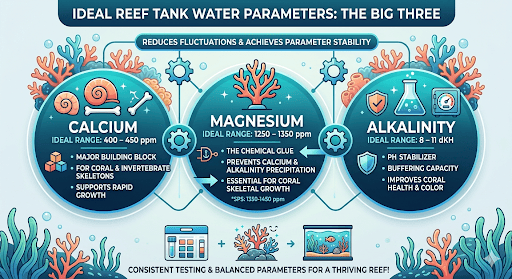
Reef enthusiasts go by a common rule of thumb where the reef tank calcium and magnesium balance rests on a ratio of approximately 3:1. In other words, for every 420 ppm, the magnesium should be thrice as much, at least 1,260 ppm.
To truly master your tank’s health, you need to understand how to balance reef tank water chemistry like a pro to ensure the reef tank parameter stability.
Low Magnesium Symptoms in Reef Tank & High Magnesium Effects Explained
Low Magnesium Symptoms in a Reef Tank
If the magnesium ppm in reef tank dips below 1,200, your tank will start giving signals that magnesium is far below recommended levels:
Common low magnesium symptoms in a reef tank include:
- Difficulty in maintaining Calcium/Alk in the precise ratio. No matter how many boosters you add, the levels drop almost immediately.
- You can notice poor coral growth even with perfect lighting.
- LPS corals may show recession or tissue loss at the base.
- Low magnesium levels can trigger sudden Algae outbreaks.
High Magnesium Effects in a Reef Tank
While magnesium is generally less toxic than other elements, “more” than is necessary can be counterproductive for your tank.
If levels exceed 1,500–1,600 ppm, you might notice:
- Lethargic Behavior: Snails and other invertebrates may fall off the glass or stop moving.
- Coral Bleaching: A rapid spiking of magnesium t levels can shock sensitive Acropora.
- Algae Death: Interestingly, Magnesium Sulfate, which consists of high volumes of magnesium, was used to combat Bryopsis algae, though this is less common today with modern treatments.
Maintaining Magnesium in a Saltwater Aquarium
Consistency is the cornerstone of a successful reef tank. Maintaining magnesium in a saltwater aquarium is less of a challenge if you follow a structured approach.
Regular Testing
Test your magnesium levels at least once every two weeks. An increase in coral load is followed by rising consumption levels.
Water Changes
It’s generally sufficient to regularly change the water with a high-quality salt mix to replenish magnesium in tanks with soft corals or low demand.
Automated Dosing
Reefer with many stony corals performs magnesium dosing in a reef tank via a dosing pump. This allows them to inject small, frequent doses that prevent the seesaw effect of manual dosing.
Magnesium Dosing Reef Tank Strategies
The best approach to follow when levels get low is to go slow. Do not raise your magnesium by more than 50 ppm per day.
- Use high-quality supplements with the right Magnesium chloride vs. Magnesium sulfate ratio.
- Re-test 24 hours after dosing to determine the effect of dosing.
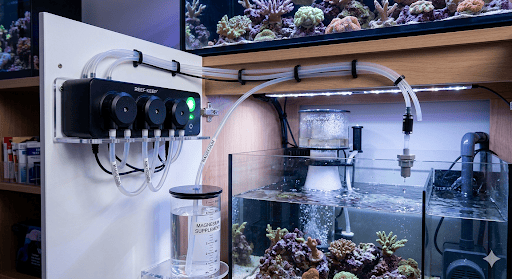
Automated dosing pump setup for maintaining magnesium in a saltwater aquarium.
The Role Of Reef Tank Water Parameters
In the world of reef keeping, a stable number is often better than a fluctuating “perfect” number. Reef tank parameter stability is necessary to allow corals to build their immune systems and develop vibrant colors.
Magnesium provides the chemical buffer that makes stable conditions possible. If your magnesium is swinging wildly, your alkalinity will get off balance, which is one of the biggest coral killers.
Why Your Alkalinity Dosing Isn’t Working
If you find yourself dosing heavily, you are merely “chasing” Alkalinity numbers, and your tank is likely to crash in the next 24 hours. This happens due to an internal process called abiotic calcification.
When the reef tank calcium and magnesium balance goes awry, the water becomes “supersaturated.” In this state, the Calcium and Carbonate ions are not able to stay in solution but physically bond to each other and fall out of solution as sand.
This is the “silent killer” of reef stability. Keeping your magnesium at the correct levels essentially “blocks” this bond, allowing corals to consume the expensive supplements available for dosing.
Our reef tank dosing calculator can help you determine the exact amount of product required to reach your target ppm without overshooting.
Final Thoughts
Magnesium might not appear to be as attractive as the latest LED light or a rare Scolymia, but it works as the silent engine of your reef. Achieving the ideal magnesium range reef tank paves the way for a resilient, stable environment where corals calcify and thrive in the true sense.
Stop doing the math in your head. Magnesium dosing requires precision to avoid the 50ppm/day safety limit. ReefKG’s system memory tracks your consumption trends and calculates your exact dosage, ensuring you never overshoot the safe zone.
Download the ReefKG App & Stabilize Your Reef Today.
Frequently Asked Questions: Reef Tank Magnesium
What is the ideal magnesium range in a reef tank?
The ideal magnesium range in a reef tank is between 1,250 and 1,350 ppm. In heavily stocked with SPS corals, recommended levels are closer to 1,400 ppm to ensure mineral availability.
How often should I test magnesium in a reef tank?
You should check the magnesium level in your reef tank at least once every two weeks. Regular testing helps maintain the stability of reef tank parameters for ideal water chemistry, even though magnesium is consumed more slowly than calcium or alkalinity.
Can high magnesium kill corals?
Yes, excessively high magnesium exceeding 1,600 ppm can stress or kill corals and invertebrates. While magnesium is not as toxic as high calcium or alkalinity, sudden spikes can cause bleaching and tissue damage.
What causes low magnesium in a reef tank?
The use of a salt mix with low initial magnesium levels, the consumption of coral during skeletal growth, and infrequent water changes are the three main causes of low magnesium symptoms in a reef tank. If magnesium is not replenished through magnesium dosing, corals gradually lose the magnesium required to stop calcium precipitation as they grow.